It's quite a lovely city with a very suburban "feel" about it. We saw a variety of people, including many children. It seems to be nicely laid out, and there are many beautiful Arab-style houses, some painted in vivid colors. Unfortunately, I didn't take any pictures. Perhaps on our next visit!
Wednesday, May 4, 2011
A drive in Tuba-Zangariye
Yesterday, we had some time between classes, so we decided to take a short drive. Believe it or not, there's a city that we can see from our house but which we had never been to. Its a Bedouin town named Tuba-Zangariyye (actually, I think it was once 2 separate villages that have since grown together). It's located a short distance east of highway 90, the other side of the highway from Rosh Pinna. These Bedouins, although they are, of course, Muslims, have been allies of the Jews since the early days.


New album soon to be available!
I'm excited that everything is now finished with my latest album הללו בעוגב Halelu B'Ugav ("Praise with the Organ"). I sent it off to CD Baby on Sunday. They should get it in about 1-2 weeks, and it will take them another 2-3 weeks to process it. Then it will be available for sale. You'll then be able to order a CD or buy and download either the whole album or individual tracks from them.
Here's a picture of the cover:

Finally, here's a link to my home page where you can read a little more about this album, as well as my previous albums.
Monday, April 25, 2011
Victor Halvani Park HaPsalim
After returning from our trip to the Hills of Gilboa, David took a nap and I went for a walk. One of the places I visited on my walk was the Victor Halvani Sculpture Park (named for the sculptor), which is located right by the main entrance to our neighborhood, נווה אורנים Neve Oranim ("Pine Oasis"). Here are a couple of pictures I took there. In the first one, you can see the large antenna tower in our neighborhood on the right side of the picture:

In this picture, you can see the name of the park in large letters made of concrete. The name can be translated as "Victor Halvani Sculpture Park" or, more irreverently, as "Victor Halvani Park of the Idols". :-)


The Hills of Gilboa and Har Barkan
Since today is the last day of פסח Pesakh ("Passover") here in Israel, it is a holiday. We decided to drive to the Hills of Gilboa. We went to הר ברקן Har Barkan ("Mt. Barkan") where some beautiful deep purple irises bloom every year. But, this year, we were too late, and they were already gone. However, there were still many other lovely flowers, and the view was great since it was quite a clear day. Here are some pictures I took there.
Here's a nice shot of some interesting purple flowers:

These flowers are quite small, but the light makes them sparkle like gold in the photo. Notice the tiny bug on one of them:

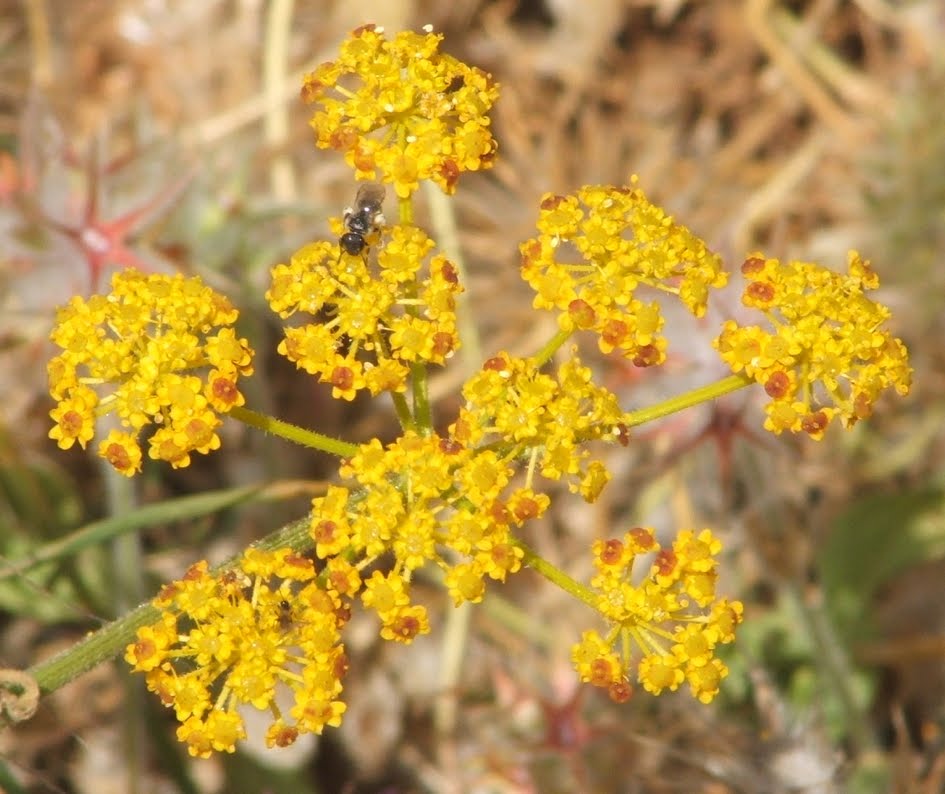
These pink flowers are quite small, and there are also a lot of them in the pasture near our house:


Here's an interesting insect just sitting on the rock in the trail:


I saw a few thistles like this one. Can you spot the 2 bugs in this picture?


These pink hollyhocks are in bloom all over the place right now!


This is the look-out tower at the top of Har Barkan:


I shot the next four photos from the top of the tower pictured above.
This is the view looking east toward the Jordan River Valley. The city on the left is Beit She'an, one of the 10 towns of the Decapolis in Roman times. The hills in the background are on the other side of the Jordan River in the Kingdom of Jordan.


This is the view looking south. Har Barkan is just north of שומרון Shomron ("Samaria"), the more accurate name for the northern part of the so-called "West Bank", the part of the Palestine Mandate that was illegally occupied by the Kingdom of Jordan from 1948 until 1967. In the foreground of this shot and on the left, you can see part of the separation barrier. If you look carefully, on the right side you can see an Arab village in Shomron, complete with 2 minarets.


This is the view looking west. In the distance in this photo, you can barely see הר כרמל Har Karmel ("Mt. Carmel"). At its right end is the upper part of the city of חיפה Haifa, right by the Mediterranean Sea.


Here's the view looking north. In the foreground is the parking lot. You can barely see the roof of our little red car at the near end. Further up in the shot, you can see the fertile Jezreel Valley. Still further back, on the left, is Har Tavor ("Mt. Tabor"). On a REALLY clear day, you might be able to see Tsfat. I think it would be a little to the right of the center. It WAS clear enough to see Har Tavor from Tsfat today.


And, finally, I just couldn't resist. Here's a nice shot of our wonderful new car, sitting right there in the parking lot!


I want to end by commenting on what these views show about Israel. The first thing that should strike you is how small it is. From this one point, you can see Jordan, much of Shomron, nearly to the Mediterranean, and nearly up to Lebanon and Syria. Or, to put it another way, you can see almost all of northern Israel and parts of several neighboring countries.
Why the sea parted?
Here's an interesting sign we saw when shopping at BIG in Karmiel this week. The Hebrew words at the bottom translate to "shopping and gifts for Passover are done only at Big". And here you thought that the reason the sea parted was so that we could escape from Pharaoh and his army!

What is Freedom?
Pesach is the holiday of freedom, and it lasts a whole week. So during this week, my mind has kept returning to this topic. I think now, perhaps, it's time to try to organize some of these thoughts and try to write a coherent essay on the matter.
Let's start by considering the word "freedom"; its Latin-derived synonym, "liberty"; and their related words: "free", "liberate", "liberated", "liberation", "liberal", and "libertarian". Notice the variety of connotations, feelings, and ideologies that these represent. This brings us to the first point that I'd like us to note: "freedom" and "liberty" have many complex layers of meaning and many different contexts of application.
The first, most intimate level of freedom is the personal one. Roughly, this means that an individual person is free to do what he or she likes and is not controlled by anyone or anything else.
If we think for a moment about this and its implications, it immediately bring us to what I believe is the most important thing we must consider. Freedom is NEVER absolute. Even if you were the only person in the universe, you would not be completely free. You can't travel to the moon just because you fancy doing so. If you jump off the cliff, gravity will take its course, and the collision at the bottom is likely to end all of your freedoms forever! Furthermore, you are NOT the only person, and the very existence of others means that your freedom is limited by their presence and by your need and, perhaps, desire to interact with them. Every person's freedom is limited by the freedoms of others in the environment.
Now let's start at the other end: slavery. At first thought, we think we know what this means -- one person "owns" another. This kind of slavery is quite easy to define, and it can be outlawed, as it has been essentially throughout the world (of course, outlawed things do not completely disappear just because they are illegal!). But there are other, more subtle kinds of slavery, as well. A desperately poor man may not be owned by his rich neighbor, but he may still have to do many things that he would not choose for himself, just to survive. A woman from a disadvantaged background may spend her whole life serving others in a way that is hard to distinguish from actual slavery.
Economic wealth and other kinds of social and political power certainly bring MUCH more freedom to some people than others have. A rich woman can quit a job she doesn't like a lot more readily than a poorer one. A wealthy man has many more options regarding where he lives, what he does, where and when he travels, and, in general, what his life can be like. The Hebrew word for slavery is עבדות avdut, which comes from the root that means "work". The emphasis, then, was NOT on ownership but on who had to do the work. In this sense, perhaps we could say that MOST of us are slaves in the modern world! Very few of us can actually live without having to work at all. And it's absolutely certain that the world simple could not function if NO ONE had to work!
Let's consider another type of freedom that is very important, especially in the modern Western world: political freedom. For Americans especially this usually means the freedoms and rights that are delineated in the U.S. constitution: freedom of speech, freedom of the press, freedom of religion, freedom of peaceable assembly, and so on. We tend to think of these as absolutes, but, in reality, NONE of them actually are.
Let's start with freedom of speech and its close relative, freedom of the press. The first limitation here is the proverbial one: you are NOT free to yell "FIRE!" in a crowded theater! More seriously, though, you are not free to bully and intimidate others, and you are not free to incite others to murderous actions. You are also not free to say or publish deliberate falsehoods for the purpose of ruining others' reputations. If you do, you may be sued for libel, and rightly so.
Freedom of religion can be particularly difficult in actual implementation. Let's start with an extreme example -- you are NOT free to kill your neighbor no matter how much your religion may say that you must! But there are also many more realistic and subtle limits. To what extent are you allowed to proselytize (i.e. to try to convince others to join your religion)? What are the limits on the public practice of your religion? Can you blast calls to prayer out on loudspeakers at whatever hour your religion requires? What about ringing church bells? Most of these questions have been dealt with in different ways by different countries at various times. Almost all of the answers reflect more the political and social situations than any kind of absolute notion of freedom of religion.
Even freedom of assembly can be problematic. If large numbers of people plan to gather in a given area, the issues of crowd control can become a matter of life and death. For this reason, prior coordination with some kind of authority is surely important and, of necessity, puts some limits on this basic freedom.
Finally, I'd like to talk about another kind of freedom, one that's not as familiar to Americans perhaps: group or ethnic or national freedom. The Israeli national anthem, התקווה HaTikvah ("The Hope"), speaks of our desire להיות עם חופשי בארצנו lihyot am khofshi b'artzenu ("to be a free people in our Land"). What does this mean? It's surely about more than individual and political freedoms, things which we can have, at least subject to the general limitations discussed above, in many countries in the modern world. It's something more communal, more cultural. It includes our desire to determine our own collective destiny, to avoid having to depend on others for the continuation, development, and free expression of our national identity.
Of course, this type of freedom also has its limits. Even the United States, certainly the most militarily powerful country in the world today, feels the need to cultivate allies and get some kind of international consensus, however limited, for most of its operations. How much more so is this true of tiny Israel, even though we have of necessity managed to develop a formidable military.
And so my conclusions are that freedom is never absolute but is always a continuum. It has many aspects and operates and many different levels. Perhaps this is why we have a holiday every year that focuses on this topic. May we ALL be freer next year than we are now!
Saturday, April 23, 2011
20 years later, the Cold War is really over
Last night was a unique experience at Emet V'Shalom, our Reform congregation in Nahariya. As you may recall, our rabbi, Israel Horovitz, is on a 6-month sabbatical. So, very lay congregants and visiting rabbis have been leading the prayers. Last night, Mark Sirontinski had volunteered to lead. As he explained at the beginning, he had led services many times in Russian, but this was his first time in Hebrew, and he was doing it in memory of his father, who was a captain in the Red Army but was killed in battle (along with many thousands of other Russians) in 1942.
Mark is a retiree from Russia and one of the very few Russians who regularly attends our synagogue regularly. His Hebrew is perhaps not even quite at the level of mine, and his English is only a little better. But we do manage to communicate.
Normally at EVS, just one person leads, but Mark wanted a khazzan (cantor) to assist him, so Norm, the chair of the ritual committee, ask me if I would help him. Of course I agreed. Mark and I communicated a bit by e-mail, and then we met 45 minutes before the start time to do our final coordination.
Mark made a few brief remarks at various times before and between the prayers, he led a few of the songs, and he did some of the readings. I led most of the songs, and we recruited the Shchorry kids, Odelia and Eyal (native Hebrew speakers), to do other readings that neither Mark nor I were prepared to attempt in public. I noticed that Mark used transliterated Hebrew (i.e. Hebrew written with Cyrillic letters -- the alphabet used for Russian and a few other languages). It was a little strange watching him read letters which I don't completely know but hearing Hebrew come out that I do know and understand!
Who of us would have thought, at the height of the Cold War, that someday an American and a Russian would stand together side by side to lead Friday night prayers in Nahariya, Israel? But, in fact, the story is even more interesting. Mark used to work for the U.S.S.R. missile program, and I used to work for the U.S. ballistic missile program!
Subscribe to:
Posts (Atom)